Finding an Indonesian palm sugar supplier is relatively easy. A search across international B2B marketplaces and supplier directories can quickly produce numerous producers, traders, aggregators, and exporters.
Finding a supplier that can consistently meet your commercial specifications, quality requirements, volume, packaging, documentation, and delivery expectations is a different challenge.
For international food manufacturers, ingredient buyers, distributors, and procurement teams, supplier selection is not simply about finding the lowest price. Product consistency, traceability, documentation, communication, and the ability to meet specifications over repeated orders can be equally important.
Two suppliers may both describe their product as “premium palm sugar” while delivering noticeably different characteristics in color, aroma, texture, moisture, particle size, or solubility. For commercial food production, these differences can affect formulation, processing, and product consistency.
This guide explains the key considerations when sourcing palm sugar from Indonesia and what international B2B buyers should look for when evaluating an Indonesian palm sugar supplier.
What Is Indonesian Palm Sugar?
Finding an Indonesian palm sugar supplier is relatively easy. A search across international B2B marketplaces and supplier directories can quickly produce numerous producers, traders, aggregators, and exporters.
Finding a supplier that can consistently meet your commercial specifications, quality requirements, volume, packaging, documentation, and delivery expectations is a different challenge.
For international food manufacturers, ingredient buyers, distributors, and procurement teams, supplier selection is not simply about finding the lowest price. Product consistency, traceability, documentation, communication, and the ability to meet specifications over repeated orders can be equally important.
Two suppliers may both describe their product as “premium palm sugar” while delivering noticeably different characteristics in color, aroma, texture, moisture, particle size, or solubility. For commercial food production, these differences can affect formulation, processing, and product consistency.
This guide explains the key considerations when sourcing palm sugar from Indonesia and what international B2B buyers should look for when evaluating an Indonesian palm sugar supplier.
What Is Indonesian Palm Sugar?
Indonesian palm sugar is a traditional sweetener produced from the sap of palm species cultivated in Indonesia.
The term “palm sugar” can refer to products made from different palm species. In the Indonesian market, two commercially important categories are aren sugar (gula aren), made from the sap of the Arenga palm, and coconut sugar (gula kelapa), made from coconut palm sap.
The production process generally begins with harvesting sap from the palm. Because fresh sap is highly perishable, it needs to be processed relatively quickly.
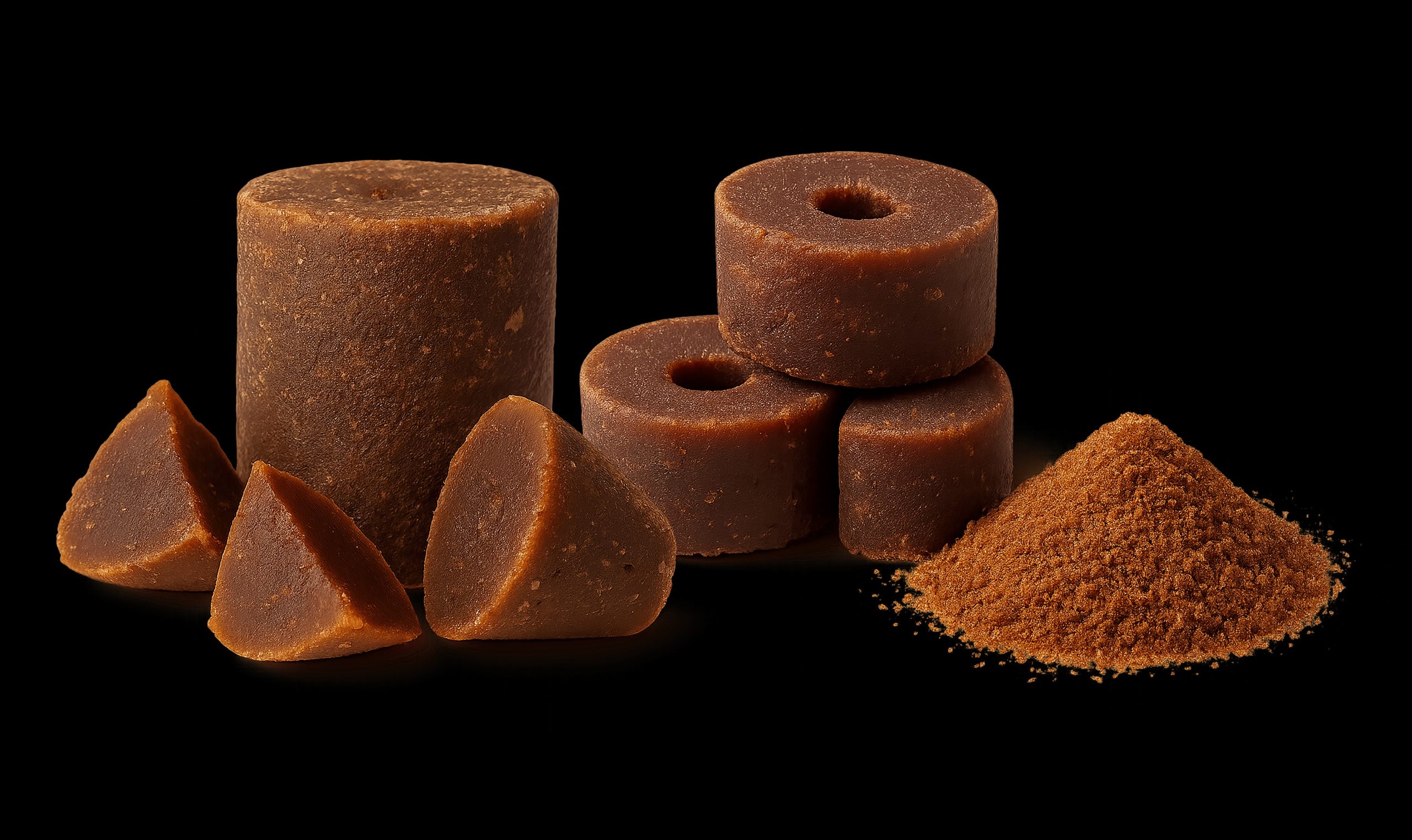
The sap is traditionally heated to reduce its water content and concentrate its natural sugars. Depending on the production method and intended application, the concentrated product can then be formed into blocks, cakes, granules, powder, or other commercial formats.
For B2B buyers, the production method matters because differences in raw material handling, processing, filtration, drying, storage, and packaging can influence the consistency of the finished product.
This is why product sourcing should go beyond simply asking: “Do you supply palm sugar?”
A professional sourcing process should establish exactly what type of palm sugar is required, what specifications must be met, and whether the supplier can consistently meet those requirements.
Aren Palm Sugar vs. Coconut Sugar
One of the most important distinctions for international buyers is the difference between aren palm sugar and coconut sugar.
Although both are natural sweeteners derived from palm-family crops, they come from different sources and can have different characteristics and commercial applications.
| Feature | Aren Palm Sugar (Gula Aren) | Coconut Sugar (Gula Kelapa) |
|---|---|---|
| Primary source | Arenga palm sap | Coconut palm sap |
| Common Indonesian name | Gula Aren | Gula Kelapa |
| Typical flavor | Rich, caramel-like, deeper flavor profile | Generally milder caramel profile |
| Typical appearance | Often darker, depending on processing | Often lighter, depending on processing |
| Common applications | Beverages, sauces, traditional foods, bakery and specialty products | Bakery, beverages, confectionery and food formulations |
| Procurement consideration | Define botanical source and desired flavor clearly | Define botanical source and processing specification clearly |
The exact appearance, flavor, texture, and processing characteristics can vary between suppliers and production methods.
For this reason, buyers should define the botanical source and product specification clearly in their sourcing request.
If your requirement is specifically gula aren, do not simply request “palm sugar.”
Likewise, if your requirement is specifically coconut sugar, make sure the supplier understands that the product must be derived from coconut palm sap.
Why Source Palm Sugar from Indonesia?
Indonesia has a long-established tradition of producing palm-based sweeteners, supported by agricultural communities, local processing networks, and a growing export-oriented food industry.
For international buyers, sourcing from the country of origin can provide access to a wider range of producers and product formats than relying solely on distributors in a third country.
Potential advantages include:
- Access to Indonesian producers and processors
- Product variety across different formats and specifications
- Origin-based procurement and supply-chain visibility
- Potentially more flexible sourcing options
However, country of origin alone does not guarantee quality. The buyer still needs to evaluate each supplier based on the specific requirements of the intended application.
Forms of Palm Sugar Available for B2B Buyers
Palm sugar can be available in several commercial formats. Actual availability depends on the supplier, processing capability, and buyer requirements.
Granules or Crystals
Granulated palm sugar is suitable for applications where a dry, measurable, and relatively uniform ingredient is required.
- Particle size
- Moisture
- Flowability
- Solubility
- Color
- Flavor
- Packaging
- Storage stability
Powder
Palm sugar can also be supplied in a finer powdered format. This may be suitable for certain dry mixes, beverage preparations, bakery applications, or formulations where rapid blending is required.
Blocks or Cakes
Traditional block or cake forms remain relevant for traditional food applications, specialty products, and certain Asian food markets.
Liquid or Syrup
Some suppliers may offer palm sugar in liquid or syrup form for beverage, foodservice, sauce, or other applications. Buyers should request detailed specifications before proceeding.
What B2B Buyers Should Check Before Buying
Price should not be the only factor when selecting an Indonesian palm sugar supplier. Before requesting a commercial quotation, establish a clear product specification.
Product Specification
- Botanical source
- Product form
- Color
- Flavor profile
- Moisture specification
- Particle size or mesh
- Solubility
- Purity
- Packaging
- Shelf-life requirements
Food Safety and Quality
Food safety requirements depend on the destination market and intended use. Depending on the buyer’s requirements, relevant areas may include:
- Microbiological specifications
- Heavy metals
- Physical contaminants
- Chemical contaminants
- Allergen management
- Hygiene controls
- Traceability
- Batch identification
- Laboratory testing
Consistency Between Batches
A supplier may provide an excellent sample but still struggle to reproduce the same characteristics in subsequent production. For recurring B2B procurement, buyers should consider production capacity, raw material sourcing, quality controls, storage, packaging, traceability, and the ability to reproduce approved specifications.
Looking for Reliable Sourcing in Indonesia?
Let Susiami Goo handle the groundwork, rigorous quality control, and export logistics for your specific commodities.
Submit Requirement HereHow to Evaluate an Indonesian Palm Sugar Supplier
Supplier existence does not necessarily mean supplier suitability. A producer may make a good product for the domestic market but lack the infrastructure, documentation, communication, or consistency required for international B2B procurement.
1. Business Identity
Verify the supplier’s legal business identity and relevant Indonesian business registration. For export transactions, confirm that the supplier has the appropriate capability and documentation for the intended transaction.
2. Production Capability
Understand where and how the product is produced. Where appropriate, request facility information, production process information, production capacity, product photographs, packaging photographs, and relevant quality-control information.
3. Product Specifications
Ask for a clear specification sheet and ensure that the specification corresponds to the actual product being offered.
4. Quality Documentation
Depending on the product and destination, buyers may request a Certificate of Analysis, laboratory test results, quality certificates, food safety documentation, and other relevant compliance documents.
5. Traceability
Ask how the supplier manages raw material and production traceability. The level of traceability required depends on the buyer, product, destination, and regulatory environment.
6. Communication
A supplier should be able to understand and respond accurately to questions about specifications, quantity, packaging, production lead time, documentation, shipping, and quality requirements.
Why Sample Approval Matters
International buyers should avoid making large purchasing decisions based solely on photographs, descriptions, or a supplier’s standard specification sheet. A physical sample allows the buyer to evaluate the actual product.
- Appearance
- Color
- Aroma
- Flavor
- Texture
- Solubility
- Particle size
- Moisture
- Application performance
Food manufacturers should ideally evaluate the sample within the actual intended application. When a sample is approved, buyers may also retain a reference sample for comparison with future shipments, subject to appropriate storage conditions.
MOQ and Volume Considerations
There is no universal MOQ for Indonesian palm sugar. Minimum order quantities can vary according to product form, supplier, processing requirements, packaging, customization, production capacity, destination, and shipping method.
Shipping economics also influence the practical order size. A smaller shipment may have a lower initial purchase quantity but a higher freight cost per kilogram. The most suitable order volume should be determined based on the buyer’s actual procurement requirements and logistics economics.
B2B Packaging Requirements
Packaging should be selected according to the product, transportation conditions, storage environment, destination requirements, and buyer specifications.
- Food-grade inner liners
- Moisture protection
- Bag strength
- Carton or sack specifications
- Palletization
- Container loading
- Labeling
- Batch identification
If wooden pallets are used for international shipment, the buyer and supplier should confirm applicable treatment and marking requirements for the destination.
Export Documentation for Palm Sugar
Documentation requirements vary according to the destination country, product classification, buyer requirements, applicable food regulations, customs requirements, and shipping arrangements.
- Commercial Invoice
- Packing List
- Bill of Lading
- Certificate of Origin
- Certificate of Analysis
- Product specification sheet
- Food safety or health-related documents where applicable
- Other export or regulatory documentation where required
Not every shipment requires every document listed above. Buyers should confirm the exact requirements with their customs broker, importer of record, and relevant authorities before finalizing the transaction.
How to Source Palm Sugar from Indonesia
- Define Your Requirement — Specify the product type, form, application, quantity, quality requirements, packaging, destination, documentation, certification, and timeline.
- Identify Suitable Suppliers — Search for suppliers whose capabilities match the requirement.
- Verify Supplier Capability — Review business information, production capability, documentation, and quality controls.
- Review Product Specifications — Compare the supplier’s specification with your own requirements.
- Request Samples — Obtain a representative sample before committing to a large order.
- Evaluate Quality — Test the product according to its intended application.
- Confirm Commercial Terms — Discuss price, MOQ, Incoterms, payment terms, lead time, packaging, and shipment arrangements.
- Finalize Documentation and Packaging — Confirm exactly which documents and packaging specifications are required.
- Coordinate Production — Maintain communication during production and ensure agreed specifications are followed.
- Coordinate Shipment — Coordinate the supplier, freight forwarder, documentation, and shipping schedule.
How Susiami Goo Farmer Can Help
Sourcing from Indonesia can be challenging when the buyer is located thousands of kilometers away. Language differences, supplier verification, product specifications, documentation, quality control, and logistics can all create additional procurement work.
Susiami Goo Farmer operates as a B2B Sourcing & Supply Partner from Indonesia.
We help international buyers communicate their requirements and identify suitable Indonesian supply options.
- Supplier Sourcing and Screening — Identify potential Indonesian suppliers according to the buyer’s product, quality, volume, and documentation requirements.
- Product Matching — Help match buyer requirements with available Indonesian products and suppliers.
- Sample Coordination — Coordinate product samples between Indonesian suppliers and international buyers.
- Quality and Documentation Coordination — Help coordinate product specifications, testing, inspection, and relevant documentation.
- Supply Coordination — Support communication and coordination from supplier selection through procurement and shipment preparation.
The exact sourcing process depends on the buyer’s requirements and the scope of each project.
Frequently Asked Questions
What is Indonesian palm sugar?
Indonesian palm sugar refers to palm-derived sweeteners produced in Indonesia. The term can include products made from different palm species, including aren palm sugar and coconut sugar. Buyers should specify the exact botanical source and product type required.
What is the difference between palm sugar and coconut sugar?
The terms can be used differently in different markets. For B2B procurement, it is important to distinguish between aren sugar, produced from Arenga palm sap, and coconut sugar, produced from coconut palm sap.
Can I buy palm sugar in bulk from Indonesia?
Yes. Indonesian suppliers can offer palm sugar in various commercial formats and quantities, depending on their production capabilities and the buyer’s requirements.
How do I find a reliable Indonesian palm sugar supplier?
Evaluate the supplier’s business identity, production capability, product specifications, quality controls, documentation, communication, and ability to maintain consistency. Samples and appropriate due diligence are recommended before committing to a commercial order.
What forms of palm sugar are available?
Depending on the supplier, palm sugar may be available in granules, powder, blocks or cakes, and liquid or syrup forms. Availability and specifications vary between producers.
What specifications should I request from a supplier?
Specifications may include botanical source, product form, color, moisture, particle size, solubility, purity, microbiological requirements, packaging, shelf life, and other food safety parameters.
What documents may be required to import palm sugar?
Requirements vary by destination country and transaction. Buyers may require commercial and shipping documents, certificates of origin, product specifications, certificates of analysis, and other food or regulatory documentation.
What affects palm sugar MOQ?
MOQ can depend on product form, processing requirements, packaging, customization, supplier capacity, and shipping economics.
Can palm sugar suppliers provide samples?
Many B2B suppliers can provide samples, although availability and sample arrangements vary. Buyers should request a representative sample and evaluate it against their actual product requirements.
Can Susiami help source palm sugar according to specific requirements?
Yes. Susiami Goo Farmer can help international buyers communicate their requirements and identify suitable Indonesian sourcing options, including supplier sourcing, product matching, sample coordination, quality coordination, documentation coordination, and supply coordination.
Looking for an Indonesian Palm Sugar Supplier?
Finding a supplier is only the first step.
For international B2B procurement, the more important questions are whether the supplier can consistently meet your specifications, communicate effectively, provide the required documentation, and support your intended supply requirements.
If you are looking for palm sugar from Indonesia and need help identifying suitable sourcing options, comparing suppliers, coordinating samples, or managing procurement from Indonesia, tell us what you need.
Looking for Reliable Sourcing in Indonesia?
Let Susiami Goo handle the groundwork, rigorous quality control, and export logistics for your specific commodities.
Submit Requirement Here